Contact centers are under more pressure than ever to deliver fast, personalized, and effortless experiences on every channel. Contact center AI 컨택 센터 인공지능 has become the most powerful way to meet those expectations while boosting efficiency, supporting agents, and controlling costs. The rise of AI in call centers is transforming how businesses operate, enabling smarter decision-making and more seamless customer interactions.
This guide explains what contact center AI is, how it works, the benefits you can expect, and practical steps to get started. Whether you run an in‑house operation or work with outsourced partners, you will see how AI can turn your contact center into a strategic growth engine.
Beyond AI itself, businesses are exploring ways to handle high-demand computing tasks efficiently. Solutions like high-performance distributed computing platforms allow organizations to scale their operations without massive infrastructure costs. Meanwhile, understanding the latest trends in supercomputing helps companies predict customer needs faster and optimize resource allocation.
Marketing strategies are also evolving alongside technological innovation. Agencies that focus on customer-focused marketing approaches can design campaigns that seamlessly integrate AI-driven insights from contact centers. Some brands even leverage advanced digital marketing techniques for contact center performance to boost agent productivity and enhance customer satisfaction.
Financial and operational insights matter just as much as technology. Tools and guides on top financial resources for business growth provide decision-makers with actionable intelligence, ensuring that AI investments are both efficient and cost-effective. By combining these resources with intelligent systems, companies can deliver more personalized experiences without overloading their teams.
Top 10 Contact Center AI Solutions to Boost Customer Experience
When it comes to delivering fast, personalized, and effortless customer service, contact center AI solutions are essential. These platforms help businesses automate routine tasks, empower agents, and provide insights that improve customer satisfaction. Here are the top 10 solutions in the market today:
1. Bright Pattern
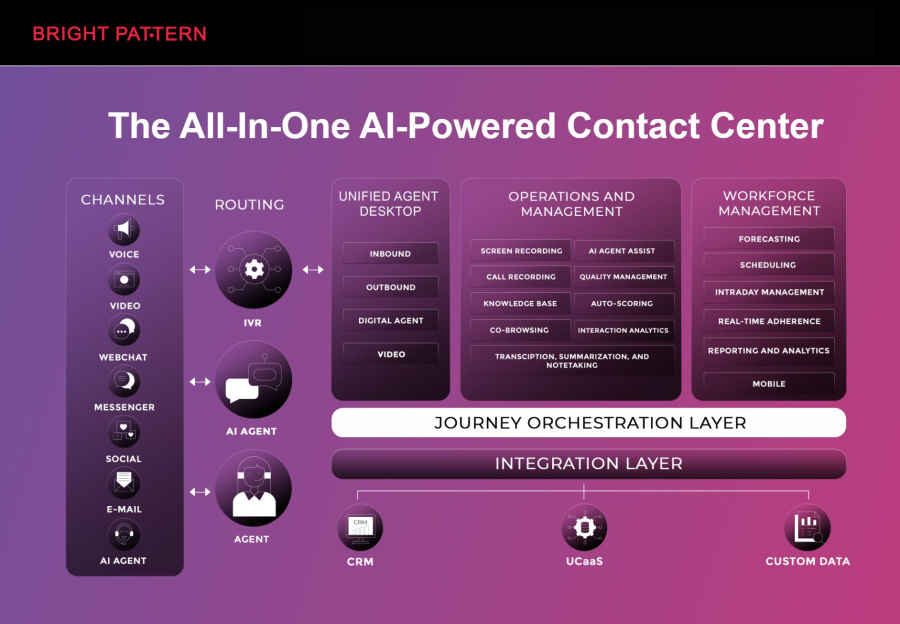
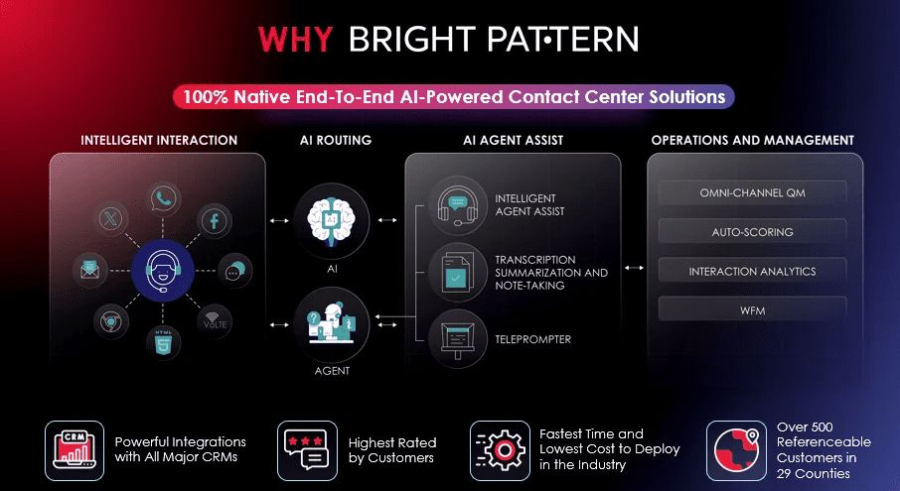
Bright Pattern is a leading provider of contact center AI that helps organizations streamline operations and deliver exceptional customer experiences. The platform integrates AI-powered automation with human agents to create seamless, omnichannel interactions. With Bright Pattern, businesses can reduce wait times, improve first-contact resolution, and gain actionable insights from every customer interaction.
Key features include:
- Omnichannel support including voice, chat, email, and messaging apps
- AI-driven chatbots and virtual assistants
- Advanced analytics and reporting for real-time performance monitoring
- Intelligent routing to match customers with the best agent
- Easy integration with CRM systems and other business tools
Bright Pattern’s AI technology ensures that both customers and agents experience efficient and personalized service, making it an ideal solution for organizations of any size.
2. Genesys
Genesys offers a comprehensive contact center AI platform that enhances agent productivity and automates routine interactions. It includes predictive routing, speech analytics, and omnichannel engagement tools.
3. NICE inContact
NICE inContact provides a cloud-based AI contact center solution with workforce optimization, analytics, and AI-driven customer engagement to improve operational efficiency.
4. Five9
Five9 combines AI-powered automation and predictive analytics with omnichannel support to streamline contact center operations and enhance the customer experience.
5. Talkdesk
Talkdesk’s AI-driven contact center platform focuses on intelligent workflows, conversational AI, and agent assist tools to reduce handle times and improve customer satisfaction.
6. RingCentral Contact Center
RingCentral provides AI capabilities such as virtual agents, sentiment analysis, and predictive routing to optimize performance and reduce wait times.
7. 8x8 Contact Center
8x8 leverages AI to automate tasks, provide agent recommendations, and deliver data-driven insights to improve customer engagement and operational efficiency.
8. Amazon Connect
Amazon Connect is a cloud-based contact center solution with machine learning-powered AI features, including chatbots, voice analytics, and personalized routing.
9. Cisco Contact Center
Cisco combines AI, automation, and omnichannel support to create a flexible, scalable contact center solution that enhances agent productivity and customer satisfaction.
10. Twilio Flex
Twilio Flex offers a fully programmable contact center platform with AI integrations, real-time analytics, and customizable workflows to optimize customer interactions.
What Is Contact Center AI?
Contact center AIis a set of artificial intelligence technologies that automate, assist, and optimize customer interactions across phone, chat, email, social, and messaging channels.
Instead of relying only on IVRs and manual processes, AI can:
- Understand natural language in voice and text conversations.
- Resolve common questions automatically through virtual agents and chatbots.
- Guide human agents in real time with next best actions and recommendations.
- Analyze every interaction to uncover trends, sentiment, and opportunities.
- Predict needs, workloads, and outcomes to optimize staffing and performance.
The result is a smarter contact center that combinesautomationandhuman expertiseto deliver consistently better customer experiences.
Core Components of Contact Center AI
A modern AI powered contact center typically brings together several key capabilities.
1. Virtual Agents and Conversational IVR
Virtual agentsand AI driven IVR systems interact with customers in natural language, not rigid menu trees. They can:
- Answer common questions like order status, billing, and password resets.
- Authenticate customers and gather context before handing off to an agent.
- Perform transactions such as bookings, payments, and updates.
- Route calls intelligently based on intent, value, and agent skills.
Because they operate 24 / 7 and scale instantly, virtual agents are one of the fastest ways to reduce wait times and improve responsiveness.
2. AI Chatbots and Messaging Automation
AI chatbots bring similar capabilities to web chat, in app messaging, and social channels. They can handle high volume inquiries, guide users step by step, and seamlessly transfer conversations to live agents when needed.
Well designed chatbots excel at:
- Self service troubleshooting and how to guidance.
- Order tracking, account changes, and appointment scheduling.
- Proactive notifications and follow ups within messaging threads.
- Collecting rich context before engaging an agent, so handoffs are smooth.
3. Real Time Agent Assist
Agent assisttools listen to or read live conversations and provide agents with instant guidance. Typical features include:
- Suggested replies and scripts based on what the customer just said or typed.
- Real time knowledge search so agents can surface the right article in seconds.
- Next best action recommendations, such as offers, steps, or escalation paths.
- Compliance prompts and reminders when required language should be used.
This makes every agent feel like an expert, reduces training time, and increases first contact resolution.
4. AI Powered Routing and Workforce Optimization
AI can continuously optimizewhohandleswhichinteraction andwhen, based on data instead of static rules. Common uses include:
- Predicting interaction volume to schedule the right number of agents.
- Routing customers based on intent, sentiment, language, and profile.
- Matching high value or at risk customers with top performing agents.
- Balancing workloads to prevent burnout and reduce handle times.
5. Analytics, Sentiment, and Quality Intelligence
Contact center AI shines inanalytics. Instead of only sampling a small percentage of calls or chats, AI can evaluate nearly every interaction.
Capabilities often include:
- Automatic transcription of voice calls into searchable text.
- Sentiment analysis to understand customer emotion and effort.
- Keyword and topic detection to surface trends and root causes.
- Automated quality scoring and coaching suggestions for agents.
These insights help leaders make better decisions about processes, policies, and training that directly raise customer satisfaction.
Business Benefits of Contact Center AI
When implemented thoughtfully, contact center AI delivers measurable gains across service quality, operations, and financial performance.
1. Faster Service and Shorter Wait Times
- Virtual agents and chatbots handle high volume, repetitive questions instantly.
- Smarter routing connects customers with the right resource the first time.
- Agent assist reduces time spent searching for information or asking supervisors.
The outcome is consistently lower average handle time and shorter queues, even during peak periods.
2. Higher Customer Satisfaction and Loyalty
- Customers get help on the channels they prefer, at any time of day.
- Interactions feel more relevant because AI uses context and history.
- Issues are resolved on the first contact more often, with less effort.
These improvements typically translate into strongerCSAT,NPS, and customer lifetime value.
3. Empowered, Less Stressed Agents
AI is at its best when itaugmentspeople. For agents, that means:
- Fewer repetitive questions and more interesting, complex conversations.
- Real time coaching and guidance instead of waiting for post call feedback.
- Reduced after call work as summaries and notes are generated automatically.
This leads to higher engagement, quicker onboarding for new hires, and lower attrition.
4. Lower Cost per Contact and Scalable Operations
- Self service deflects routine inquiries away from live agents.
- Automation streamlines workflows such as authentication and data entry.
- Accurate forecasting and routing minimize overstaffing and overtime.
You gain capacity to handle more customers without linearly increasing headcount.
5. Rich Insights for Continuous Improvement
Because AI can analyze every interaction, leaders gain a constantly updated view of:
- Top drivers of contact volume and repeat contacts.
- Common failure points in digital and physical journeys.
- Agent behaviors that correlate with successful outcomes.
Armed with this visibility, you can prioritize high impact fixes that improve experiences at scale.
Real World Use Cases for Contact Center AI
Across industries, organizations are using AI to transform specific customer and agent journeys.
1. Intelligent Self Service
AI powered self service allows customers to complete tasks independently, such as:
- Checking balances, order status, and delivery updates.
- Resetting passwords or updating account details.
- Scheduling, rescheduling, or canceling appointments.
- Finding tailored product recommendations or plan options.
When designed well, self service reduces friction and frees agents to focus on higher value conversations.
2. Peak Season and Crisis Handling
During product launches, holidays, or service disruptions, volumes can spike dramatically. Contact center AI helps by:
- Scaling virtual agents instantly to absorb routine inquiries.
- Prioritizing and routing urgent or high value contacts.
- Providing real time guidance to agents on emerging issues.
This keeps experiences stable and responsive when customers need help most.
3. Sales and Upsell Support
AI is not just for support; it can also drive revenue. Common examples include:
- Recommending add ons or upgrades during service conversations.
- Identifying at risk customers and suggesting retention offers.
- Guiding agents through structured discovery questions.
In this way, the contact center evolves from a cost center into a powerful sales channel.
4. Compliance and Risk Management
For regulated industries, AI can enhance compliance by:
- Detecting when mandatory disclosures or phrases are missing.
- Monitoring conversations for prohibited language or promises.
- Flagging interactions that require review or follow up.
Automated monitoring reduces manual sampling and helps standardize quality.
5. Multilingual and Global Support
Language capabilities are another powerful advantage. Contact center AI can:
- Support conversations in multiple languages through virtual agents.
- Assist monolingual agents by translating customer messages in real time.
- Unify analytics across regions by normalizing and analyzing multilingual data.
How Contact Center AI Works Behind the Scenes
Different platforms use different architectures, but most contact center AI solutions follow a similar flow.
1. Data Ingestion and Integration
AI connects with your existing systems, such as:
- Telephony and contact center platforms.
- CRM and ticketing tools.
- Knowledge bases and policy documents.
- Customer feedback and survey systems.
This gives AI access to the context it needs to understand customers and make accurate recommendations.
2. Understanding Customer Intent
When a customer speaks or types,natural language processingmodels convert that input into machine readable meaning. They identify:
- The intent, such aspay my billorchange my flight.
- Relevant entities like dates, locations, and product names.
- Sentiment and urgency based on wording and tone.
3. Decisioning and Orchestration
Once the AI understands intent, it decides what to do next. Options include:
- Triggering a self service workflow.
- Escalating to a live agent with full context.
- Providing the agent with suggested responses and actions.
- Updating back end systems as steps are completed.
4. Continuous Learning and Optimization
Over time, AI systems learn from outcomes, feedback, and new data. This can improve:
- Recognition accuracy for intents and entities.
- Routing decisions and next best actions.
- Response quality and conversation flows.
With the right governance, your contact center becomes smarter every week without massive reprogramming.
Key Metrics and KPIs for Contact Center AI
To capture the full value of contact center AI, it helps to track a balanced set of performance indicators.
|
Metric |
What It Measures |
How AI Improves It |
|
First Contact Resolution (FCR) |
Percentage of issues resolved in a single interaction. |
Better routing, guided workflows, and rich context raise resolution rates. |
|
Average Handle Time (AHT) |
Average time agents spend on each interaction. |
Self service deflection and agent assist shorten calls and chats. |
|
Customer Satisfaction (CSAT) |
Customer rated satisfaction with an interaction. |
Faster, clearer, more personalized experiences lift scores. |
|
Net Promoter Score (NPS) |
Likelihood of customers recommending your brand. |
Reliable service builds trust and advocacy over time. |
|
Self Service Containment |
Percentage of issues resolved without agent assistance. |
High quality virtual agents and bots handle more tasks end to end. |
|
Cost per Contact |
Total cost divided by number of interactions. |
Automation and optimization reduce cost while maintaining quality. |
|
Agent Turnover |
Rate at which agents leave the organization. |
Less stress and better tools encourage retention. |
Practical Steps to Implement Contact Center AI
A successful journey from traditional operations to an AI enabled contact center is best approached in stages.
1. Clarify Goals and Use Cases
Start by defining what you want to achieve. Common goals include:
- Reduce average handle time or queue length.
- Increase self service adoption for specific tasks.
- Improve first contact resolution on complex scenarios.
- Enhance compliance in regulated interactions.
Then identify concrete use cases that support those goals, such aspassword reset virtual agentoragent assist for new product launches.
2. Assess Data and Technology Readiness
Take stock of your current environment:
- Interaction channels in scope (voice, chat, email, messaging).
- Existing telephony, CRM, and contact center platforms.
- Availability and quality of knowledge articles and process documentation.
- Historical interaction data for training and benchmarking.
3. Choose the Right AI Capabilities
Based on your goals, decide which components to prioritize first. Examples:
- High volume, simple queries: start with virtual agents and chatbots.
- Complex or regulated calls: begin with agent assist and analytics.
- Operational efficiency focus: emphasize forecasting and routing optimization.
4. Design Customer Centric Journeys
Successful AI experiences are designed around customer needs, not technology constraints. Consider:
- Using natural, conversational language in prompts and messages.
- Keeping paths short and focused on outcomes, not menus.
- Offering an easy way to reach a human when needed.
- Testing flows with real customers and adjusting based on feedback.
5. Prepare Agents and Leaders
AI is most effective when agents and leaders see it as a partner. Best practices include:
- Explaining how AI will reduce low value tasks and support performance.
- Training agents on new tools such as real time guidance and knowledge search.
- Equipping supervisors with dashboards and insights for better coaching.
6. Pilot, Measure, and Iterate
Launch AI in a limited scope first, such as one channel, queue, or region. During the pilot:
- Track key metrics like containment, CSAT, and handle time.
- Collect qualitative feedback from customers and agents.
- Refine conversation flows, routing rules, and knowledge content.
Once results are validated, you can confidently scale to more use cases.
Best Practices for Maximizing Value
To unlock the full benefits of contact center AI, keep these guiding principles in mind.
1. Start Small but Think Big
Begin with high impact, low complexity use cases that prove value quickly, while designing your architecture for long term expansion.
2. Keep a Human in the Loop
AI should not replace human judgment in sensitive scenarios. Always provide clear paths to reach live agents, and let agents override AI suggestions when necessary.
3. Invest in Knowledge and Content
AI is only as strong as the knowledge it draws from. Up to date articles, clear policies, and well structured product information dramatically improve outcomes.
4. Prioritize Trust, Privacy, and Transparency
Customers are more comfortable with AI when they understand how it is used. Communicate clearly when they are interacting with a virtual agent and how their data is protected.
5. Collaborate Across Teams
The most successful initiatives involve customer service, operations, IT, compliance, and analytics teams working together with shared goals and KPIs.
Industry Specific Opportunities
Different sectors can apply contact center AI in ways that match their unique customer journeys.
Retail and E Commerce
- Order tracking, returns, and exchanges via virtual agents.
- Personalized product suggestions based on browsing and purchase history.
- Proactive notifications on shipping updates and back in stock items.
Financial Services
- Secure self service for balance checks, transfers, and card controls.
- Fraud alerts and dispute handling with guided workflows.
- Compliance monitoring on sales and advice conversations.
Healthcare and Insurance
- Appointment scheduling and reminders through conversational IVR and chat.
- Benefits explanations and claim status updates.
- Routing sensitive cases to specialized teams with full context.
Telecommunications and Utilities
- Outage information and restoration estimates via self service.
- Plan changes, add ons, and usage explanations through bots.
- Network troubleshooting with step by step guided flows.
Travel and Hospitality
- Booking changes, check in, and itinerary help on any channel.
- Real time updates on delays, gate changes, and policy adjustments.
- Upsell of ancillary services such as upgrades and add ons.
The Future of Contact Center AI
Contact center AI continues to evolve rapidly. Emerging capabilities include:
- More natural, human like conversations with advanced language models.
- Richer voice analytics that can detect frustration and intent early.
- Deeper integration with marketing, sales, and product teams for closed loop journeys.
- Expanded use of automation for after interaction work and follow ups.
As these technologies mature, the contact center will play an even more central role in building long term customer relationships.
Frequently Asked Questions About Contact Center AI
Is contact center AI meant to replace human agents?
No. In most organizations, AI is used to handle repetitive tasks and assist agents, not replace them. The most successful strategies blendautomationwithhuman empathy and expertise.
How quickly can we see results?
Timelines depend on scope, but many teams see measurable improvements in containment, handle time, or satisfaction within a few months of launching targeted pilots.
Do we need a large team of data scientists?
Modern contact center AI platforms are increasingly accessible, with out of the box models and configuration tools. Specialized expertise is valuable, but you can often begin with existing operations and IT teams.
What about data security and privacy?
Responsible AI deployments follow strict security, privacy, and governance practices. This typically includes encryption, access controls, and clear data retention policies aligned with regulations.
Bringing It All Together
Contact center AI offers a powerful way to transform how you serve customers, support agents, and grow your business. By combining virtual agents, real time agent assist, intelligent routing, and rich analytics, you can deliverfaster, more personalized, and more reliableexperiences on every channel.
With a clear strategy, strong collaboration, and a focus on customer centric design, your contact center can become one of your most valuable competitive advantages in the age of AI.
